Is Kentucky a High Radon Area? Radon Levels, Maps & Testing in Southern Kentucky
Quick Summary: Yes. Kentucky is considered a moderate-to-high radon state, with many counties classified as EPA Zone 1 or Zone 2. The EPA recommends testing every home regardless of county because elevated radon levels have been found throughout Kentucky.
If you're a homeowner in Bowling Green or anywhere in Southern Kentucky, you may be wondering: Is Kentucky a high radon area?
The short answer is yes.
"Radon plays a role in about 1,000 new cases of lung cancer annually in Kentucky," says Stacy Stanifer, Assistant Professor, University of Kentucky College of Nursing.
Kentucky is considered a moderate-to-high radon state, with many counties classified by the Environmental Protection Agency (EPA) as having elevated radon potential. In fact, Kentucky consistently ranks among states where homeowners should take radon exposure seriously, regardless of where they live. A late 2025 Kentucky Lantern article cited radon as one of the factors, besides smoking, making Kentucky a high-risk state for lung cancer.
Because radon is colorless, odorless, and tasteless, the only way to know whether your home has elevated levels is through testing. Whether you live in Bowling Green, Warren County, Logan County, Simpson County, Allen County, Barren County, or elsewhere in Southern Kentucky, understanding your radon risk is an important step in protecting your family's health.
Why Is Radon Common in Kentucky?
Radon is a naturally occurring radioactive gas. It's produced when uranium breaks down in soil, rock, and groundwater. As the gas forms underground, it can move through cracks in foundations, crawlspaces, sump pits, utility penetrations, and other openings before accumulating inside homes and buildings.
Kentucky's geology plays a major role in its radon risk. Much of the state is characterized by limestone bedrock and karst terrain, which can facilitate the movement of radon gas through the ground.
"Much of the state's beautiful scenery, particularly the horse farms of the Inner Bluegrass, is [actually] the result of the development of karst landscape," notes the University of Kentucky.
Areas with significant underground rock formations often experience higher radon concentrations than regions with different geological conditions.
Because geology varies across the state, radon levels can differ from county to county, and even from one home to the next.
Kentucky Radon Zones Explained
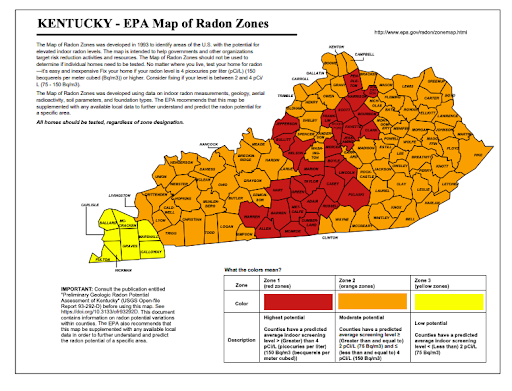
The EPA developed a national radon zone map to help homeowners understand radon potential throughout the United States.
What Are EPA Radon Zones?
EPA radon zones are based on predicted average indoor radon levels:
| EPA Zone | Predicted Average Radon Level |
|---|---|
| Zone 1 | Greater than 4.0 pCi/L |
| Zone 2 | Between 2.0 and 4.0 pCi/L |
| Zone 3 | Less than 2.0 pCi/L |
Zone designations are intended to indicate regional risk. They do not predict the radon level in an individual home. (Map Source: EPA.gov)
How Kentucky Counties Compare
Many Kentucky counties fall into EPA Zones 1 or 2, indicating elevated radon levels are common throughout the state. Even counties considered lower risk can still contain homes with dangerous radon concentrations.
Tennessee actually has more EPA Zone 1 (highest radon potential) counties than Kentucky, both in raw numbers and as a percentage of counties. Tennessee has 41 Zone 1 counties out of its 95 total counties (roughly 43%), while Kentucky has roughly 30 to 32 Zone 1 counties out of its 120 total counties (about 25%).
| EPA Zone | Meaning |
|---|---|
| Zone 1 | Highest Radon Potential |
| Zone 2 | Moderate Radon Potential |
| Zone 3 | Lower Radon Potential |
The EPA stresses that every home should be tested, regardless of its zone designation, because neighboring homes can yield dramatically different test results.
What Are Acceptable Radon Levels in KY?
One of the most common questions homeowners ask is: What are acceptable radon levels in Kentucky?
The answer is the same throughout the United States because the EPA uses national action guidelines.
| Radon Level | Recommendation |
|---|---|
| Under 2 pCi/L | Low risk |
| 2–4 pCi/L | Consider mitigation |
| 4+ pCi/L | EPA recommends action |
| 8+ pCi/L | High-priority mitigation |
The EPA recommends mitigating any home that tests at or above 4.0 picocuries per liter (pCi/L). However, many radon professionals also encourage homeowners to consider mitigation when levels fall between 2.0 and 4.0 pCi/L, particularly if vulnerable family members live in the home.
Because no amount of radon exposure is considered completely risk-free, lower levels are always preferable.
Radon Averages in Scott County, KY
For homeowners researching radon in Kentucky, Scott County is often cited for its notably elevated average radon levels.
Available county-level testing data indicate that Scott County has reported average indoor radon levels of approximately 6.4 pCi/L. This average exceeds the EPA action level of 4.0 pCi/L, underscoring why radon remains a concern throughout Kentucky.
However, county averages only tell part of the story.
A home's radon level depends on several factors, including:
Soil composition
Foundation type
Construction methods
Ventilation
Seasonal conditions
Local geology
As a result, two homes located on the same street can have vastly different radon readings. While county averages help identify areas of concern, testing remains the only way to determine a home's radon level.
What About Bowling Green and Southern Kentucky?
Homeowners throughout Southern Kentucky often assume radon is primarily a concern in northern parts of the state. Unfortunately, that's not the case.
Warren County Radon Risk
Warren County's geology and soil conditions create opportunities for radon gas to enter homes through foundation cracks, crawlspaces, and slab penetrations. Radon can still be present whether a home is older or newly constructed.
Radon in Bowling Green Homes
Bowling Green residents should not assume their home is safe simply because they haven't experienced symptoms. Radon exposure occurs silently over time, and many homes with elevated levels show no visible warning signs.
Homes with basements, crawlspaces, or slab-on-grade foundations can all experience elevated radon levels.
Radon in Logan, Simpson, Allen, and Barren Counties
Communities throughout Southern Kentucky share similar geological characteristics that can contribute to radon accumulation.
This includes:
Logan County
Simpson County
Allen County
Barren County
Monroe County
Butler County
Edmonson County
Testing is the only reliable way to understand your home's risk.
Kentucky's Lung Cancer Problem and Why Radon Matters
Radon is the second leading cause of lung cancer in the United States and the leading cause among non-smokers.
This issue is especially important in Kentucky, which continues to face significant challenges related to lung cancer and tobacco use. Recent reporting by the Kentucky Lantern has highlighted Kentucky's ongoing struggle with some of the nation's highest rates of lung cancer diagnoses.
When smoking and radon exposure occur together, the risk increases dramatically. According to the EPA, smokers exposed to elevated radon levels face a significantly greater likelihood of developing lung cancer than individuals exposed to either risk factor alone.
Because radon exposure occurs silently over many years, testing and mitigation remain among the most effective ways homeowners can reduce their long-term risk.
How Do You Know If Your KY Home Has High Radon Levels?
The truth is, you can't see, smell, or taste radon. Even if your home is brand new, has no basement, or your neighbors have tested low, elevated radon levels can still be present.
The only way to know whether your home has a radon problem is through professional radon testing.
At The Nashville Radon Guys, we provide professional radon testing for homeowners throughout Bowling Green, Warren County, and Southern Kentucky. Our testing process delivers accurate results and gives you a clear understanding of your home's radon levels, helping you make informed decisions about your family's health and safety.
Should You Test Your Home Even If Your Neighbor's Levels Were Low?
Absolutely. One of the biggest misconceptions about radon is that neighboring homes will have similar readings.
In reality, two homes sitting side by side can produce dramatically different test results due to differences in construction, foundation design, ventilation, and soil conditions.
A neighbor's test result does not predict your home's radon level.
That's why the EPA recommends testing every home, regardless of location, age, or county designation.
Schedule Radon Testing in Bowling Green & Southern Kentucky
If you're concerned about radon in KY, the best first step is to have it professionally tested.
The Radon Guys provide radon testing and mitigation services throughout Southern Kentucky, including:
Warren County
Logan County
Allen County
Simpson County
Barren County
Scottsville
Franklin
Glasgow
Whether you're purchasing a home, selling a property, or simply want peace of mind, professional radon testing can help you understand your risk and protect your family.
Contact The Radon Guys today to schedule radon testing or mitigation services in Bowling Green and throughout Southern Kentucky.